


China's Pinglu Canal: A New River-to-Sea Gateway for Southwest China and ASEAN Trade
Author: [2026-09-16] | By Xiamen AE Global. Vicky, Vicky@xmaelogistics.com
China's Pinglu Canal has officially opened to navigation, creating a new river-to-sea connection between the Xijiang River shipping system in southwest China and the Beibu Gulf in Guangxi.
For international shippers, manufacturers, importers, exporters, and logistics professionals, this is more than a major infrastructure project. The canal changes how cargo from parts of southwest China can reach the coast and connect with international shipping routes toward ASEAN and other overseas markets.
The 134.2-kilometer Pinglu Canal is designed for vessels of up to 5,000 tonnes and forms a key part of China's New International Land-Sea Trade Corridor. Official information indicates that the route can shorten the inland waterway distance from southwest China to the sea by more than 560 kilometers compared with traditional routes through Guangzhou, while estimated overall logistics costs could fall by approximately 18%–30%.
For a freight forwarder, however, the real question is not simply whether the canal is open. The important question is how this new waterway can be integrated with ocean freight, rail, trucking, customs clearance, warehousing, and port operations.
That is where professional freight forwarding becomes important.
Table of Contents
- What Is China's Pinglu Canal?
- Pinglu Canal Route and Key Specifications
- Why Was the Pinglu Canal Built?
- Six Key Features of the Pinglu Canal
- How the Pinglu Canal Changes Southwest China Logistics
- Pinglu Canal and Beibu Gulf Port
- What the Canal Means for Freight Forwarding
- Potential Multimodal Logistics Routes
- What Cargo Owners Should Consider
- XIAMEN AE GLOBAL Freight Forwarding Services
- Frequently Asked Questions
- Request a China Freight Forwarding Solution
1. What Is China's Pinglu Canal?
The Pinglu Canal, located in Guangxi Zhuang Autonomous Region in southern China, is a major river-to-sea waterway connecting the Xijiang River shipping network with the Beibu Gulf.
The canal starts near the Pingtang River mouth in the Xijin Reservoir area of Hengzhou, Nanning, and runs south toward Qinzhou before reaching the Beibu Gulf. Its total length is approximately 134.2 kilometers.
Construction began on August 28, 2022, with an estimated total investment of approximately RMB 72.7 billion. The canal officially opened to navigation on September 16, 2026.
Key Pinglu Canal Parameters
| Item | Specification |
|---|---|
| Canal | Pinglu Canal |
| Location | Guangxi, China |
| Total length | 134.2 km |
| Northern connection | Xijiang River / Pingtang River area |
| Southern connection | Beibu Gulf |
| Main coastal gateway | Beibu Gulf Port |
| Navigation standard | Class I inland waterway |
| Maximum vessel class | Up to 5,000 tonnes |
| Major navigation hubs | Madao, Qishi and Qingnian |
| Total water-level difference | Approximately 65 m |
| Construction start | August 28, 2022 |
| Official opening | September 16, 2026 |
| Total investment | Approximately RMB 72.7 billion |
| Strategic corridor | New International Land-Sea Trade Corridor |
The canal is described by Chinese authorities as the first major river-to-sea canal project planned and coordinated at the national level since the founding of the People's Republic of China.
2. Pinglu Canal Route and Its Geographic Importance
The significance of the Pinglu Canal comes from its location.
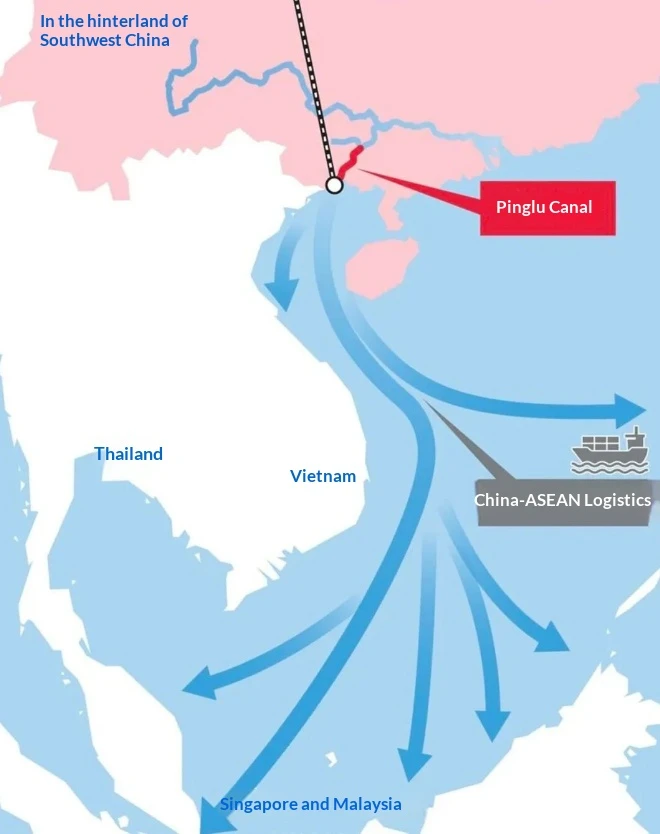
Historically, cargo from southwest China moving by inland waterways toward the sea often had to travel east through the Xijiang system before reaching Guangzhou and then continue toward international markets.
The Pinglu Canal creates a more direct southbound connection.
In simplified terms, the logistics network can be understood as:
Southwest China → Xijiang River system → Pinglu Canal → Beibu Gulf → International ocean shipping
This connection gives inland cargo a new route toward the sea and strengthens the relationship between inland cities, Guangxi, Beibu Gulf ports, and international shipping networks.
The canal also connects with China's New International Land-Sea Trade Corridor, which combines inland waterways, railways, highways, and maritime transport to connect western China with international markets.
3. Why Was the Pinglu Canal Built?
For many years, Guangxi had an unusual geographic situation: it was close to the sea and connected to major river systems, but the natural direction of many rivers did not provide a straightforward southbound river-to-sea route.
The Pinglu Canal addresses this bottleneck.
Its purpose is not simply to create another navigation channel. It is designed to improve the connection between:
- Southwest China's inland manufacturing regions
- The Xijiang River economic belt
- Guangxi's logistics network
- Beibu Gulf Port
- ASEAN markets
- International maritime shipping routes
For cargo owners, this means another logistics option when evaluating transit time, inland transport distance, port selection, and multimodal transportation costs.
4. Six Key Features of China's Pinglu Canal
4.1 A Direct River-to-Sea Connection
The most important feature is straightforward: the Pinglu Canal connects inland river transportation with the sea.
The canal links the Xijiang River shipping network to the Beibu Gulf, giving southwest China a more direct waterborne route toward the coast.
This is particularly relevant for bulk commodities, containers, industrial products, agricultural products, machinery, and other cargo that can benefit from inland waterway transportation.
4.2 Designed for 5,000-Tonne Vessels
The Pinglu Canal is built to accommodate vessels of up to 5,000 tonnes and follows China's Class I inland waterway standard. This places the canal at a high navigation standard among China's inland waterways.
Before the canal entered operation, vessel trials included 5,000-tonne vessels as well as 3,000-tonne and 1,000-tonne vessels.
The tests covered practical operating conditions including:
- Lock navigation
- Vessel meeting and overtaking
- Turning
- Docking
- Night navigation
- Tidal conditions
- Strong winds and high tides
- Reservoir discharge
- Flooding conditions
The trial vessels were also equipped with BeiDou positioning equipment, drones, and sensors for navigation and safety monitoring.
This testing approach is particularly relevant to commercial shipping because a new waterway must be evaluated under actual operating conditions rather than simply completed as a construction project.
4.3 Three Major Navigation Hubs Manage a 65-Metre Water-Level Difference
One of the engineering challenges is the approximately 65-meter total water-level difference along the canal.
To manage this difference, three major cascade navigation hubs were constructed:
| Navigation Hub | Main Function |
|---|---|
| Madao Hub | Major navigation and water-saving ship lock |
| Qishi Hub | Navigation, water-level management and ship locking |
| Qingnian Hub | Navigation and water-level management |
The Madao Hub is particularly notable. Official sources identify it as a large water-saving ship lock, with a maximum navigation water-level difference of approximately 29.6 meters at the hub.
4.4 Water-Saving Ship Lock Technology
The canal incorporates advanced water-saving technology to reduce the amount of water required during ship-lock operations.
The Madao and Qishi hubs use a multi-level water-saving pool arrangement. Earlier project information described water-saving rates exceeding 60 percent for these systems.
The engineering objective is clear: handle substantial changes in elevation while maintaining reliable vessel operations and controlling water consumption.
This is one reason the Pinglu Canal has attracted international attention from the engineering and waterway sectors.
4.5 Digital and Intelligent Canal Management
The Pinglu Canal is also designed as a digitally managed waterway.
Its management system integrates technologies such as:
- BeiDou satellite positioning
- Cloud computing
- Artificial intelligence
- Video monitoring
- Hydrological monitoring
- Meteorological monitoring
- 5G communication
- Edge computing
- High-speed optical-fiber networks
During construction and testing, digital systems were used to monitor equipment, personnel, waterway conditions, vessel movement, and potential risks.
The long-term objective is to move from a construction-oriented digital system toward an operational system capable of supporting vessel dispatching, water-level management, traffic monitoring, and safety control.
For logistics operators, digital visibility is increasingly important because cargo movement does not end at the port gate. Inland navigation information needs to connect with vessel schedules, port operations, customs processes, and downstream transportation.
4.6 A New Link Between Southwest China and ASEAN
The strategic value of the Pinglu Canal extends beyond Guangxi.
The canal forms part of a broader transportation network connecting southwest China with the Beibu Gulf and international markets.
Official estimates indicate that cargo from southwest China can shorten its inland shipping distance to the sea by more than 560 kilometers compared with traditional routes through Guangzhou. Estimated comprehensive logistics costs could decrease by 18%–30%.
The actual benefit for an individual shipment will depend on cargo origin, destination, vessel availability, port charges, handling requirements, inland trucking, transshipment arrangements, and the final overseas destination.
That distinction matters when calculating a real freight quotation.
5. How the Pinglu Canal Could Change Southwest China Logistics
The opening of the canal creates a new logistics equation for cargo owners.
Previously, some cargo moving from southwest China to international markets had to travel through longer inland routes before reaching a major seaport.
With the Pinglu Canal, the potential route becomes more direct:
Factory / inland origin → Xijiang River → Pinglu Canal → Beibu Gulf Port → Ocean Freight → Overseas Destination
This can create several potential advantages.
Shorter Inland Waterway Distance
The canal is expected to shorten the inland waterway distance by more than 560 km compared with traditional routes through Guangzhou.
Potentially Lower Logistics Costs
Official estimates put the potential reduction in comprehensive logistics costs at approximately 18%–30%.
However, freight costs are shipment-specific. A professional Freight Forwarder should compare the entire logistics chain rather than looking only at the ocean freight rate.
Better Access to ASEAN
Beibu Gulf Port already serves as an important maritime gateway for trade with ASEAN. The canal strengthens the connection between inland China and this maritime gateway.
More Multimodal Transport Options
The canal can work together with:
- Inland waterways
- Rail freight
- Trucking
- Container terminals
- Ocean shipping
- Warehousing
- Customs clearance
This creates opportunities for more flexible multimodal freight forwarding services.
6. Pinglu Canal and Beibu Gulf Port
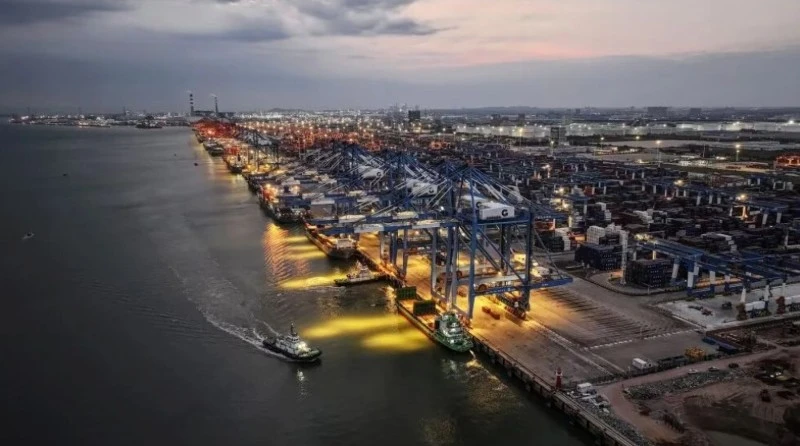
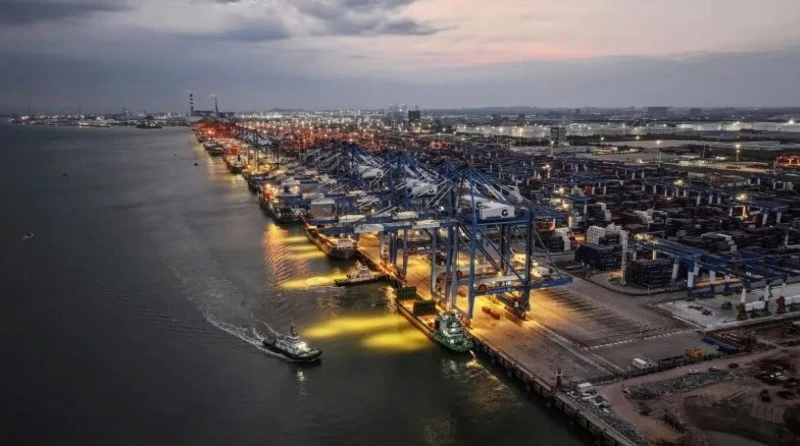
The southern end of the Pinglu Canal is connected to the Beibu Gulf region, making Beibu Gulf Port a critical part of the new logistics chain.
For international cargo, the canal itself is only one section of the journey.
A typical export shipment may involve:
- Factory pickup
- Inland transportation
- River transportation
- Pinglu Canal navigation
- Beibu Gulf port handling
- Export customs clearance
- Container loading
- Ocean freight
- Destination-port customs clearance
- Final delivery
This is why cargo owners should evaluate the entire route rather than asking only for a canal transportation rate.
According to official information, Beibu Gulf Port's container throughput increased from 2.28 million TEUs in 2017 to 10.06 million TEUs in 2025, while its shipping network covers major ASEAN ports.
7. What the Pinglu Canal Means for Freight Forwarding
The opening of the Pinglu Canal does not eliminate the need for a Freight Forwarder. Instead, it makes route planning more important.
A professional Forwarding Agent can compare different combinations of inland transportation, waterway shipping, ocean freight, customs clearance, warehousing, and final delivery.
For example, a shipper may need to compare:
| Logistics Option | Potential Advantage | Key Consideration |
|---|---|---|
| Traditional inland waterway + Guangzhou | Established logistics network | Longer inland route |
| Pinglu Canal + Beibu Gulf | More direct southbound route | Actual vessel and port schedule |
| Rail + Beibu Gulf | Suitable for time-sensitive cargo | Rail capacity and cost |
| Truck + Seaport | Flexible pickup and delivery | Higher inland transport cost for long distances |
| River + Rail + Ocean | Multimodal flexibility | More coordination points |
| Door-to-door forwarding | Single logistics contact | Requires comprehensive route management |
The most economical option is not necessarily the route with the lowest ocean freight rate.
The correct calculation should consider:
Total Logistics Cost = Inland Transport + Waterway/Rail Cost + Port Charges + Customs + Ocean Freight + Handling + Warehousing + Final Delivery
This is where an experienced freight forwarding service can add practical value.
8. Potential Multimodal Logistics Routes
The Pinglu Canal is particularly interesting because it can become part of a larger multimodal network.
Route A: Inland Waterway + Ocean Freight
Southwest China → Xijiang River → Pinglu Canal → Beibu Gulf Port → ASEAN / Global Destination
This is the most direct concept associated with the new waterway.
Route B: Rail + Pinglu Canal + Ocean Freight
Inland factory → Rail terminal → Guangxi → River/Canal connection → Beibu Gulf Port → Overseas market
This can be useful where cargo originates far from navigable waterways.
Route C: Truck + Pinglu Canal + Ocean Freight
Factory → Truck → Inland loading point → Pinglu Canal → Beibu Gulf Port → Ocean Freight
This can provide flexibility for factories located outside direct waterway terminals.
Route D: Integrated Multimodal Freight Forwarding
Factory → Truck → Rail/Waterway → Pinglu Canal → Beibu Gulf Port → Ocean Vessel → Destination Port → Truck → Final Customer
For international manufacturers, this type of integrated solution may be more important than any individual transport segment.
9. What Cargo Owners Should Consider Before Using the Pinglu Canal
The opening of a new waterway does not automatically mean every shipment should use it.
Cargo owners should first check several practical factors.
Cargo Origin
Where is the factory or warehouse located?
The distance between the cargo origin and the nearest practical river terminal can significantly affect the overall cost.
Cargo Type
Consider whether the shipment is:
- Containerized cargo
- General cargo
- Bulk cargo
- Heavy machinery
- Project cargo
- Break bulk cargo
- Oversized equipment
- Dangerous goods
Different cargo types may require different handling and transportation arrangements.
Vessel and Schedule Availability
The theoretical capacity of a waterway is not the same as a specific vessel schedule.
A freight forwarder should confirm available services, sailing schedules, cargo acceptance requirements, and connections before quoting a route.
Port Connection
The cargo still needs to move from the canal to an ocean-going vessel.
The efficiency of the connection between inland waterway operations and the seaport can have a major impact on the actual transit time.
Customs and Documentation
International cargo may involve:
- Export customs clearance
- Commercial invoice
- Packing list
- Bill of lading
- Certificate of origin
- Shipping instructions
- Import documentation
- Special cargo declarations
A qualified forwarding agent can coordinate these processes as part of the overall shipment.
10. Why Choose XIAMEN AE GLOBAL for China Freight Forwarding?
XIAMEN AE GLOBAL is a China-based logistics and transportation company established in 2018, providing international freight forwarding services for cargo owners and businesses.
The company is government-licensed and holds IATA, FIATA, FMC, and NVOCC-related approvals, with a network of more than 100 overseas agents.
Our services include:
- Ocean freight
- Air freight
- Courier shipments
- Customs clearance
- Warehousing
- Project cargo
- Break bulk shipments
- Door-to-door delivery
- Import and export formalities
- Shipment booking and tracking
- FOB to CIF logistics coordination
- Switch MBL and HBL handling
- Certificates of Origin and Form A assistance
- Document legalization
- BV and SGS-related coordination
We also maintain long-standing relationships with major shipping lines and provide logistics coverage involving major Chinese ports including Xiamen, Fuzhou, Shanghai, Ningbo, Shenzhen, and Guangzhou.
For cargo owners evaluating the Pinglu Canal, our role is not simply to arrange transportation.
We can help compare the complete logistics chain and identify whether a Pinglu Canal + Beibu Gulf Port solution makes practical sense for the shipment.
11. Frequently Asked Questions About China's Pinglu Canal
What is China's Pinglu Canal?
The Pinglu Canal is a major river-to-sea waterway in Guangxi, China, connecting the Xijiang River shipping system with the Beibu Gulf. It is 134.2 km long and designed for vessels of up to 5,000 tonnes.
When did the Pinglu Canal open?
The Pinglu Canal officially opened to navigation on September 16, 2026.
Where is the Pinglu Canal located?
The canal is located in Guangxi Zhuang Autonomous Region. It begins near the Pingtang River mouth in the Xijin Reservoir area of Hengzhou, Nanning, and runs south toward the Beibu Gulf through Qinzhou.
How long is the Pinglu Canal?
The total length of the Pinglu Canal is approximately 134.2 kilometers.
What size vessels can use the Pinglu Canal?
The canal is designed for vessels of up to 5,000 tonnes and was constructed according to China's Class I inland waterway standards.
How much can the Pinglu Canal shorten cargo transportation?
Official information indicates that cargo from southwest China can reduce its inland shipping distance by more than 560 kilometers compared with traditional routes through Guangzhou.
Can the Pinglu Canal reduce freight costs?
Official estimates indicate that comprehensive logistics costs could decrease by approximately 18%–30% after the canal enters operation. Actual savings depend on cargo origin, destination, cargo type, port charges, vessel schedules, inland transportation, and other shipment-specific factors.
Why is the Pinglu Canal important for ASEAN trade?
The canal provides southwest China with a more direct connection toward the Beibu Gulf and its maritime network, strengthening the transportation link between China's inland regions and ASEAN markets.
Can a freight forwarder arrange shipments using the Pinglu Canal?
A Freight Forwarder can help evaluate and coordinate multimodal transportation involving inland waterways, trucking, rail, seaports, customs clearance, ocean freight, and final delivery. The exact available route depends on the cargo origin, destination, commodity, vessel services, and operational requirements.
Should every shipment from southwest China use the Pinglu Canal?
Not necessarily. The most suitable route depends on the complete logistics calculation. A professional Forwarding Agent should compare the Pinglu Canal, rail, trucking, existing inland-waterway routes, ocean freight connections, and total door-to-door costs before making a routing recommendation.
12. Request a China Freight Forwarding Solution
The opening of China's Pinglu Canal creates a new logistics option for cargo moving between southwest China, Guangxi, the Beibu Gulf, ASEAN, and international markets.
But the value of the canal is ultimately measured at the shipment level.
If you are an importer, exporter, manufacturer, trading company, or international cargo owner, XIAMEN AE GLOBAL can help you evaluate the practical transportation options based on your cargo origin, destination, commodity, volume, container type, delivery requirements, and preferred transit time.
Instead of looking at only the ocean freight rate, let our team compare the complete logistics route.
Tell us your cargo origin, destination, commodity, volume, and preferred shipping schedule.
Our freight forwarding team can evaluate whether a Pinglu Canal + Beibu Gulf Port + ocean freight solution can work for your shipment and provide a practical China logistics quotation.
XIAMEN AE GLOBAL - Your China Freight Forwarding Partner for Ocean Freight, Air Freight, Customs Clearance, Warehousing, Project Cargo, and Multimodal Logistics.