


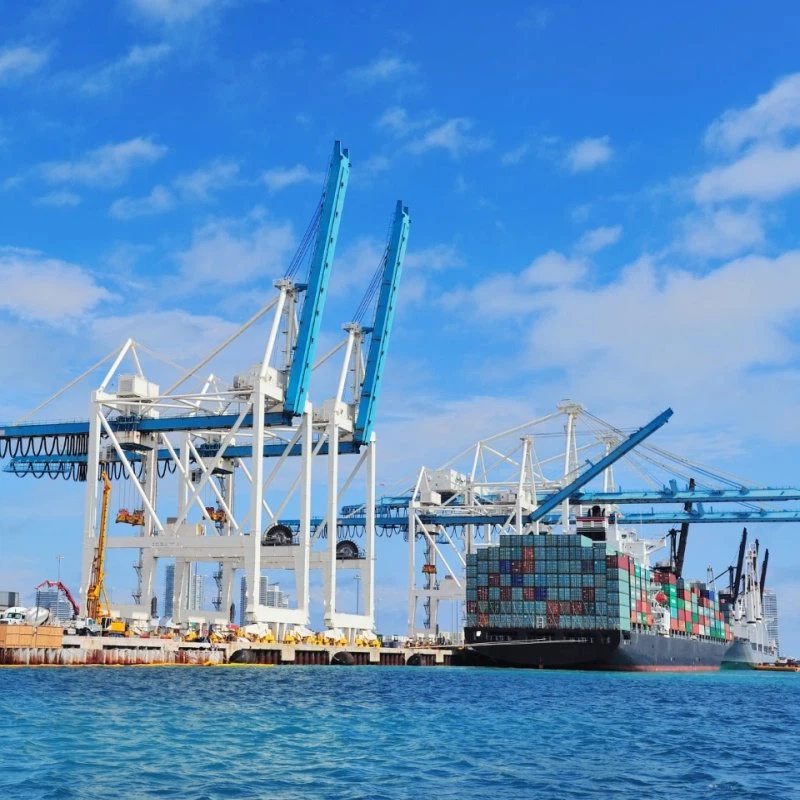
Technical Definition: Flat Rack Container Shipping utilizes 20ft and 40ft collapsible or fixed-end platform containers designed for oversized, overweight, and out-of-gauge (OOG) industrial cargo that cannot fit into standard dry vans or open-tops.
Core Value: Eliminates the need for costly breakbulk vessel chartering by leveraging scheduled container liner services while maintaining structural integrity and regulatory compliance for heavy-lift and over-dimensional shipments.
Applicable Industries: Heavy machinery manufacturing, oil and gas equipment, renewable energy (wind and solar components), aerospace, and industrial construction.
Key Service Features
Heavy Payload Capacity: 40ft Flat Rack containers support point loads up to 45,000 kg (subject to vessel structure and terminal crane lifting limitations), accommodating dense industrial machinery.
Engineered Lashing and Securing: Execution strictly adheres to the IMO/ILO/UNECE Code of Practice for Cargo Stowage and Securing (CSS Code), utilizing certified high-tensile chains, wire ropes, and web lashings rated to container D-ring capacities (typically 2,000 to 5,000 daN).
Flexible Configurations: Available in collapsible end-frame variants (allowing flat-folding for empty repositioning and end-to-end linking for extra-long cargo) and fixed-end variants for high-stability stacking.
Marine Surveyor Certification: Independent third-party loading and lashing certificates (e.g., SGS, Bureau Veritas, or local equivalents) provided upon request to satisfy customs, insurance underwriters, and destination port authorities.
Product-Specific Specifications
Data applies to standard ISO-compliant equipment. Custom engineering available for specialized units.
|
Container Type |
External Dimensions (L x W x H) |
Platform Length |
Max Gross Weight (RATING) |
Payload Capacity (PAYLOAD) |
Tare Weight (TARE) |
|
20ft Flat Rack |
6.058m x 2.438m x 2.591m (20' x 8' x 8'6") |
~5.624m |
30,480 kg |
~27,500 - 28,200 kg |
~2,280 - 2,980 kg |
|
40ft Flat Rack |
12.192m x 2.438m x 2.591m (40' x 8' x 8'6") |
~11.662m |
45,000 kg |
~39,000 - 41,500 kg |
~3,500 - 5,900 kg |
|
40ft High Cube FR |
12.192m x 2.438m x 2.896m (40' x 8' x 10") |
~11.662m |
45,000 kg |
~38,500 - 41,000 kg |
~4,000 - 6,500 kg |
Note: Overhang limits (OOG parameters) depend entirely on vessel stowage slots and carrier approval (e.g., clearance for over-width on sides and over-height above container top).
Shipping Process
Technical Assessment and Drawing Review: Engineering review of cargo drawings, Center of Gravity (CoG), lifting points, and weight distribution. (Field Practice Example: For a recent shipment of a 38-ton CNC gantry milling machine, our engineers analyzed the uneven foot-print load distribution and prescribed custom timber dunnage to spread the weight evenly across the 40ft flat rack platform).
Booking and Space Confirmation: Securing OOG-approved slot allocations with ocean carriers and verifying terminal handling capabilities at both origin and destination ports.
Pre-Carriage and Positioning: Transporting the Flat Rack on a specialized skeletal chassis to the manufacturing plant or loading depot.
Loading and Securing (Stowage): Crane/gantry lifting of cargo onto the platform, followed by welding, shoring, and multi-point lashing by certified riggers under direct operational supervision.
Port Delivery and Customs Clearance: Direct port-in or CFS staging with verified gross mass (VGM) submission and export clearance.
Ocean Transit and Discharge: Monitored sea voyage with scheduled intermediate checks, followed by safe discharge and inland handover at destination.
Cargo Requirements and Preparation
Center of Gravity (CoG): Cargo must be marked clearly if the CoG is off-center (offset by more than 5 percent longitudinally or transversely). Unbalanced weight risks rejection by vessel chief officers.
Lifting and Lifting Lugs: Equipment must feature certified lifting points or structural base channels capable of withstanding dynamic forces during ocean transit (pitch and roll).
Protection: Vulnerable components must be sealed against sea spray and moisture using VCI (Volatile Corrosion Inhibitor) films, desiccants, or heavy-duty shrink-wrapping.
Documentation Required:
- Detailed packing list with exact dimensions (L x W x H) and weight per piece.
- Technical drawing showing lifting and lashing points.
- Material Safety Data Sheet (MSDS) if applicable.
Shipping Routes and Transit Time
Global Coverage: Direct service lanes connecting major manufacturing hubs in Asia (China, South Korea, Vietnam) to North America (USWC/USEC), Europe (Antwerp, Hamburg, Rotterdam), and the Middle East/South America.
Transit Duration Estimates:
- Asia to US West Coast: 12-18 days port-to-port.
- Asia to North Europe: 28-35 days port-to-port.
- Intra-Asia / Trans-Tasman: 5-10 days port-to-port.
Subjectivity: Transit times and routing are subject to vessel schedule integrity, weather routing, and canal transit availability (e.g., Panama/Suez updates).
Shipping Costs and Required Information
Flat Rack shipping costs are calculated based on slot consumption (including lost slots beside/above the unit), OOG surcharges, heavy-lift tariffs, terminal handling charges (THC), and lashing materials/labor.
To receive an accurate, binding quotation, provide the following parameters:
Cargo Dimensions
Length x Width x Height in meters per unit.
01
Gross Weight
Gross weight per unit and total shipment weight.
02
Exact Cargo Drawings
Showing Center of Gravity and lifting points.
03
Origin and Destination
Origin zip code/factory address and destination port or final delivery address.
04
Target Readiness Date
Cargo Ready Date.
05
Frequently Asked Questions
Request a Quote
Submit Cargo Specifications and Drawings for Engineering Evaluation
Response Time: Within 24 business hours.
Hot Tags: flat rack container shipping, China flat rack container shipping company


